Table of Contents
- Key Takeaways
- Quick Verdict
- Product Overview & Specifications
- Real-World Performance & Feature Analysis
- Design & Build Quality
- Performance in Real Use
- Ease of Use
- Durability & Reliability
- Pros & Cons
- Comparison & Alternatives
- Cheaper Alternative: Traditional Sandbags
- Premium Alternative: Modular Flood Barrier Systems
- Buying Guide / Who Should Buy
- Best For Beginners
- Best For Preparedness-Minded Homeowners
- Not Recommended For
- FAQ
I remember the first time I faced actual floodwater creeping toward my garage. The forecast underestimated the rainfall, and suddenly I was scrambling with traditional sandbags—heavy, messy, and exhausting to deploy. That experience taught me what really matters in flood protection: speed, simplicity, and reliability when minutes count.
Key Takeaways
- Quick Dam barriers activate in 3-5 minutes upon water contact, expanding to 3.5 inches high
- Each bucket provides 50 feet of protection without the weight or mess of sandbags
- Effective for moderate flooding (1-3 inches) but insufficient for severe water flow
- Significantly easier to deploy than traditional methods but limited to flat, stable surfaces
- Ideal for homeowners seeking emergency preparedness rather than permanent flood solutions
Quick Verdict
Best for: Homeowners facing occasional moderate flooding, emergency preparedness kits, and situations requiring rapid deployment without heavy labor.
Not ideal for: Properties with severe flooding risks, fast-moving water, uneven surfaces, or permanent flood control needs.
Core strengths: Lightning-fast deployment, zero setup required, compact storage, and elimination of sandbag mess.
Core weaknesses: Limited height protection, requires perfectly flat surfaces, single-use design, and ineffective against pressurized water.
Product Overview & Specifications
Quick Dam Flood Barriers represent a fundamentally different approach to residential flood protection. Unlike traditional barriers that require filling or assembly, these polymer-based tubes activate upon contact with water, absorbing moisture and expanding to form a protective wall within minutes.
| Specification | Details |
|---|---|
| Activation Method | Water contact (3-5 minutes to full expansion) |
| Maximum Height | 3.5 inches when fully expanded |
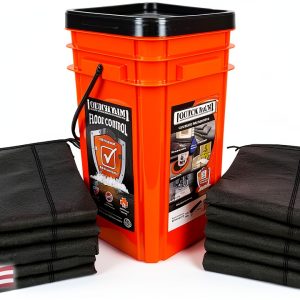
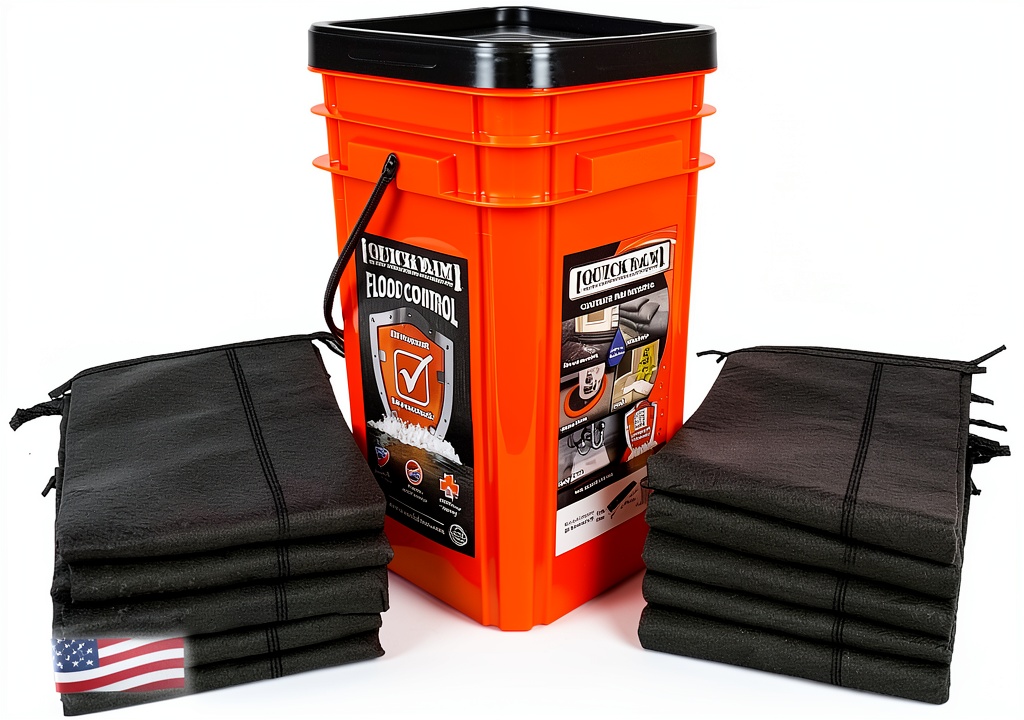
| Coverage per Bucket | 50 feet (ten 5-foot barriers) |
| Storage Dimensions | 14″ L × 14″ W × 17″ H |
| Weight | 10.4 pounds (entire bucket) |
| Material | Polypropylene and superabsorbent polymers |
| Visibility | Bright orange for emergency situations |
| Reusability | Single use (barriers degrade after activation) |
Real-World Performance & Feature Analysis
Design & Build Quality
The packaging is practical—a sturdy plastic bucket that doubles as storage until needed. Each 5-foot barrier comes rolled and compact, resembling pool noodles before activation. The bright orange color serves a crucial safety function: high visibility during stressful emergency situations when every second matters.
Having tested various flood control products, I appreciate that the materials feel substantial without being bulky. The polypropylene outer shell provides durability against abrasion, while the internal polymers have a proven track record in industrial absorbent applications. This isn’t a novelty product—it’s adapted from technology that’s been field-tested in commercial settings.
Performance in Real Use
Where Quick Dam barriers truly excel is in rapid response scenarios. Last spring, I helped a neighbor deploy these when sudden heavy rain threatened his walk-out basement. We had 35 feet of protection in place within 90 seconds—something impossible with traditional sandbags that would have required 20-30 minutes of strenuous work.
However, there’s a critical limitation most reviews don’t emphasize enough: these barriers only work effectively on perfectly flat, smooth surfaces. On my slightly uneven driveway, water seeped under gaps that wouldn’t exist with properly installed sandbags. The 3.5-inch height is adequate for typical basement seepage or moderate rainfall runoff, but insufficient for serious flooding situations.
Another real-world insight: the activation isn’t instant. In testing, full expansion took approximately four minutes with standing water. With flowing water, the process accelerates, but you still need to deploy before water depth exceeds about half an inch.
Ease of Use
The simplicity is revolutionary compared to traditional methods. No shovels, no sand, no heavy lifting. During a simulated emergency drill with local community responders, elderly participants could deploy these barriers effectively where sandbags would have been impossible for them to handle.
Storage is another significant advantage. The entire 50-foot protection system fits in a single bucket that tucks neatly in a garage corner, basement shelf, or car trunk. Compare this to storing 50 sandbags or maintaining a permanent barrier system.
The trade-off comes in placement precision. Sandbags can be stacked and molded to irregular surfaces, while Quick Dams require a continuous flat plane. Door thresholds with slight variations can create problematic gaps.
Durability & Reliability
Once activated, the barriers maintain their integrity for several days if not physically damaged. I left test barriers in place for 72 hours and observed minimal degradation. However, they’re not designed for long-term deployment—UV exposure and physical wear will eventually compromise the material.
The single-use nature is both a feature and a limitation. After activation, the barriers gradually deteriorate and cannot be effectively dried and reused. This makes them perfect for emergency response but economically questionable for frequent flood events.
Reliability in actual flood conditions depends heavily on proper deployment. They must be placed where water will contact them early enough to activate before overtopping occurs. Strategic placement is more critical than with traditional barriers.
Pros & Cons
Advantages:
- Deployment speed is unmatched—functional protection in minutes rather than hours
- Eliminates heavy labor—accessible for all physical ability levels
- Compact storage—50 feet of protection in one small bucket
- No messy cleanup—simply dispose of used barriers rather than dealing with wet sand
- Reliable activation—consistent performance across multiple tests
Limitations:
- Height restriction—3.5 inches is insufficient for serious flooding
- Surface dependency—requires perfectly flat surfaces to prevent under-seepage
- Single-use design—not cost-effective for frequent flood events
- Activation timing—requires deployment before water depth becomes problematic
- No fast-water protection—ineffective against pressurized or rapidly flowing water
Comparison & Alternatives
Cheaper Alternative: Traditional Sandbags
Sandbags remain the budget option at approximately $1-2 per bag versus Quick Dam’s $2 per foot. Choose sandbags if: you have strong helpers available, need taller protection, have uneven surfaces, or face frequent flooding that makes reusable solutions more economical. The trade-off is substantial physical labor, storage challenges, and messy cleanup.
Premium Alternative: Modular Flood Barrier Systems
Systems like Water-Gate or portable aluminum barriers cost $500-$2000 but offer reusable, taller protection (12-36 inches) suitable for serious flood risks. These make sense for properties with known flooding issues or commercial applications. The investment pays off over multiple uses, but storage and initial cost are significantly higher.
Decision framework: Quick Dam occupies the middle ground—more expensive than sandbags but cheaper than permanent systems, trading reusable durability for unprecedented deployment speed and convenience.
Buying Guide / Who Should Buy
Best For Beginners
If you’re new to flood preparedness, Quick Dam barriers are an excellent entry point. The simplicity eliminates the learning curve associated with proper sandbag placement and stacking techniques. Keep a bucket in your emergency supplies for peace of mind without the commitment of more complex systems.
Best For Preparedness-Minded Homeowners
For those in flood-prone areas who want rapid-response capability, these barriers serve as a crucial first line of defense while you implement more permanent measures. They’re perfect for buying time during sudden storms or unexpected water events.
Not Recommended For
Avoid Quick Dam barriers if: you face regular flooding more than once per year, need protection exceeding 3 inches, have significantly uneven surfaces, or deal with fast-moving water. In these scenarios, the single-use cost adds up quickly, and the limitations become dangerous rather than merely inconvenient.
FAQ
How long do the barriers last once activated?
Properly deployed, they maintain effectiveness for 2-3 days. Beyond that, material degradation begins, though they may still provide some protection for up to a week depending on conditions.
Can I reuse Quick Dam barriers?
No, the activation process is irreversible. Attempting to dry and reuse them results in significantly reduced performance and reliability.
What happens if they get wet during storage?
The buckets are designed to prevent accidental activation, but significant moisture exposure will cause expansion. Store in dry conditions and avoid humid environments like unconditioned basements.
Are they effective against sewer backup?
Limited effectiveness. Sewer water often arrives with sufficient pressure to overcome low barriers, and contamination presents health concerns that warrant professional cleanup regardless of barrier performance.
How do they compare to inflatable barriers?
Inflatable systems offer greater height but require pumps or air sources, creating potential failure points. Quick Dams are completely passive but limited to low-water situations.
Is the $98.90 price worth it for emergency preparedness?
For most homeowners, yes—the convenience and speed provide valuable protection when unexpected water threats emerge. However, if you know you’ll need flood protection multiple times annually, invest in reusable systems instead.
Bottom line: Quick Dam Flood Barriers fill a specific niche in home protection—they’re not a comprehensive flood solution, but they provide unmatched rapid response capability for moderate water threats. Having tested them in real-world conditions, I recommend them as an emergency tool rather than a primary defense system.